
The NEET result comes out, and the number on the screen isn’t the one you hoped for. Maybe you missed a government seat by a few thousand ranks. Maybe the score was far below what your mock tests promised. Either way, the next question arrives quickly, usually from a relative before you’ve had time to think: “So, are you dropping a year?”
It’s one of the hardest decisions a medical aspirant makes. A drop year can turn a 450 into a 620. It can also become twelve months of anxiety that end with a similar score. The difference rarely comes down to intelligence. It comes down to why the first attempt fell short, and what changes in the second.
This guide is written for students and parents trying to make that call honestly.
What is a NEET dropper year?
Short answer: A NEET dropper year, or gap year, is when a student finishes Intermediate (BiPC) and spends the next year preparing full-time for NEET instead of joining a degree course. Students who take this route are often called droppers or repeaters.
Because the board syllabus is already behind them, droppers can put all their energy into NEET. They don’t relearn Intermediate. Instead, they work on speed, accuracy, NCERT depth and exam temperament, which is usually where the first attempt fell short.
Is a drop year worth it? The honest answer
It is worth it if you can clearly identify what went wrong and you have a realistic plan to fix it. It is not worth it if the plan is simply “study harder” in the same way, in the same environment, with the same distractions.
A useful test: look at your first-attempt score against your target. If you were close, a focused year often makes the difference. If the gap is very large, a drop year can still work, but only if your preparation genuinely starts from the basics again rather than picking up where you left off.
Signs a drop year will likely help you
Your mock scores were good, but the exam day wasn’t. Many students lose marks to nerves, poor time management or careless errors rather than missing knowledge. These problems are fixable with enough timed practice and proper analysis after every test.
You were juggling board exams and NEET. In Intermediate, students split their energy between IPE and NEET. In a drop year, the board pressure is gone and all your time goes into one exam.
You started serious preparation late. If NEET-focused preparation only began properly in the second year of Intermediate, an extra year of structured work can close the gap.
Your environment held you back. Phones, long commutes, and an inconsistent home routine take more marks than most students admit. A change of environment can matter as much as a change of teachers.
You still want to be a doctor, and you’re sure of it. Motivation won’t carry you through the entire year, but conviction gets you through the difficult months.
Signs you should think twice
You don’t know why you scored low. If you can’t name the problem, a second year may repeat the first.
The pressure is coming mostly from others. A drop year chosen to satisfy family expectations, not your own goal, is very hard to sustain.
Your mental health took a serious hit. If the first attempt left you exhausted or low, talk to someone you trust before committing to another year of high-stakes preparation. Your wellbeing comes first, and there is no shame in taking time to recover.
You have a strong alternative you’d genuinely enjoy. BDS, AYUSH, nursing, pharmacy, biotechnology and allied health sciences are real careers, not consolation prizes. If one of them excites you, it deserves serious consideration.
The real risks of a gap year
It’s important to be honest about these:
- Isolation. Friends move on to college. Studying alone at home for a year can feel lonely, and loneliness quietly drains motivation.
- Complacency in the early months. Twelve months feels like a long time in June. By December, it doesn’t.
- Repeating the same mistakes. Same books, same routine, same distractions usually means similar results.
- Pressure building up. A second attempt carries more emotional weight. Without support, that weight affects performance.
Almost every one of these risks is about structure and environment, not ability. That’s why where and how you prepare in a drop year matters so much.
How to make a dropper year work
1. Do a proper post-mortem first. Go through your NEET paper and your mock tests. Was it Physics numericals? Chemistry concepts? Biology lines missed from NCERT? Time running out in the last 30 minutes? Write it down. This list becomes your plan.
2. Treat NCERT as your foundation. NEET questions are built on NCERT concepts. Droppers who return to NCERT with a fresh eye often find gaps they missed the first time.
3. Test often, and analyse every test. Taking a test without reviewing it is only half the work. Keep an error notebook and track the same type of mistake over weeks until it disappears.
4. Build a fixed daily routine. Classes, study hours, meals and sleep at consistent times. A routine removes the daily decision of whether to study.
5. Stay connected with people. Studying among other serious aspirants, with mentors who check in regularly, keeps both discipline and morale higher than studying in isolation.
6. Plan your phone use deliberately. Decide when and how long your phone is allowed, and stick to it, rather than relying on willpower in the moment.
Long-term coaching vs self-study in a drop year
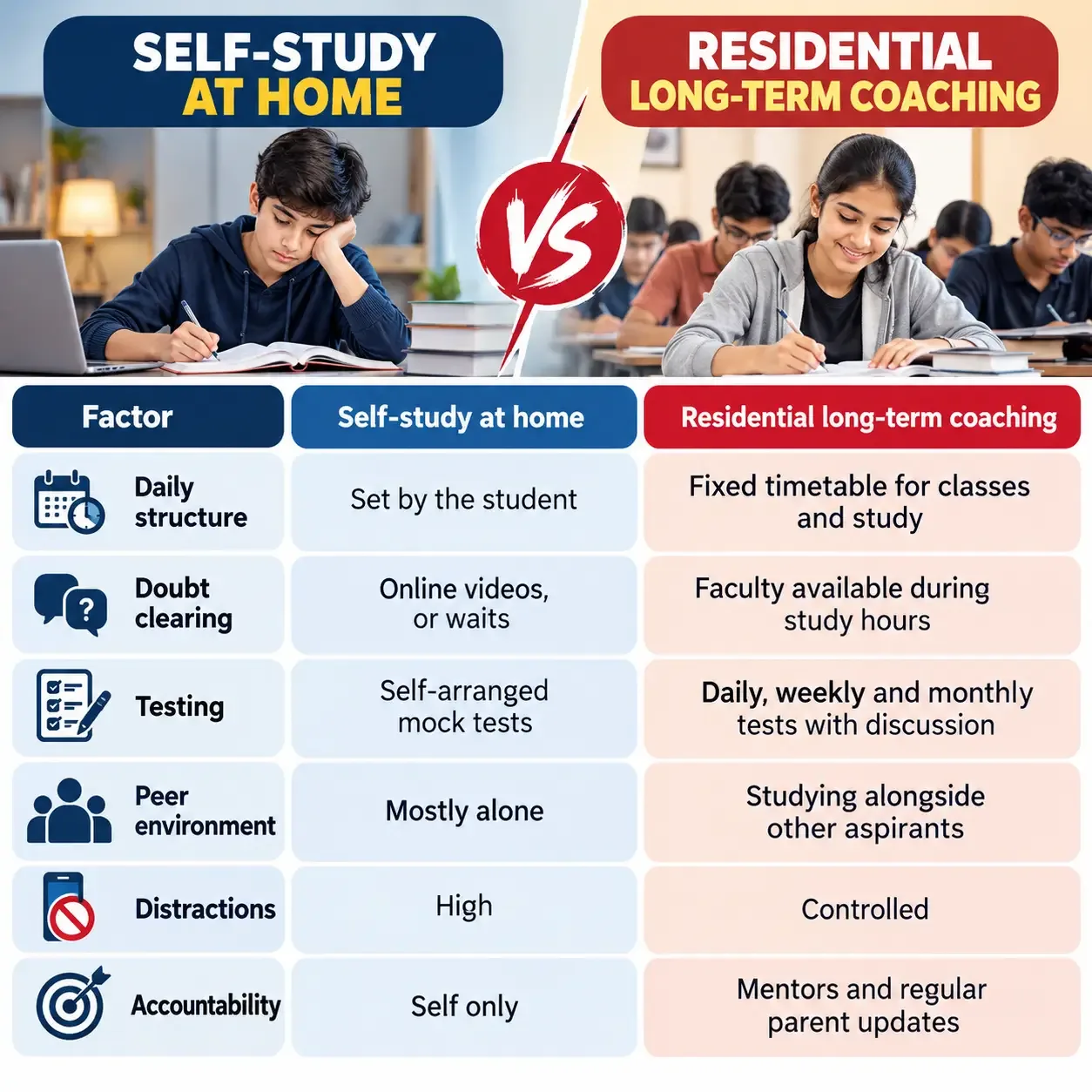
Self-study works for some highly disciplined students. For most droppers, the structure and accountability of good long-term coaching is what turns a second attempt into a better one.
How to choose the best NEET long term coaching in Hyderabad
If you’re considering coaching for your drop year, look past the advertisements and check these points in person:
- Batch size. Smaller batches mean faculty actually know your weak areas.
- Supervised study hours after class, with teachers available to clear doubts.
- A clear testing system, with discussion and analysis after every paper.
- One-on-one mentorship, not just lectures.
- A safe residential setup with separate hostels, hygienic food and medical support.
- Regular communication with parents.
At VR Doctors Academy in Hafeezpet, Miyapur, the Focus-45 Long-Term NEET Programme is built for Intermediate completers, including repeaters. It runs for 8–10 months with batches of 45 students.
Each day has 5 hours of classes followed by 5–6 hours of supervised study, with the same faculty clearing doubts. Students take Daily Review Concept Tests, Weekly Conceptual NEET Tests, Saturday Biology tests, monthly major tests and grand tests, followed by paper discussion and one-on-one mentorship every Monday.
Hostels are separate, air-conditioned and supported by an in-house sick room with doctor-on-call.
For students who want a final push closer to the exam, the 45–60 day Short-Term NEET Programme offers an intensive, NCERT-focused crash course.
Unsure whether a drop year is right for you? Visit the campus, meet the faculty, and talk your first attempt through with our counsellors before you decide. Call +91 92569 25640 or book a campus visit.
Frequently asked questions
A drop year is a good idea when you know exactly why your first attempt fell short and you have a structured plan to fix it, such as better testing, NCERT revision and a distraction-free routine. Without that clarity, a second attempt can repeat the first.