Insights
Is NEET Moving to Computer-Based Testing? What the NTA's Confirmed 2027 Shift Means for Future Aspirants

NEET day is about to look very different
For years, NEET day has looked the same: a blue-black ballpoint, an OMR sheet and three hours in a silent exam hall. That picture is about to change.
After the NEET-UG 2026 paper leak forced the cancellation of the May 3 exam and a re-test on June 21, Union Education Minister Dharmendra Pradhan announced that NEET-UG will move to computer-based testing (CBT) from 2027. The NTA has since confirmed the plan to the Supreme Court.
For students now in Class 11, Class 12 or a long-term batch, this isn't distant policy news. It changes how the exam is delivered, how scores may be calculated and how you should practise. Here's what we know so far, what's still unconfirmed, how to prepare, and what to ask when you're choosing the best NEET coaching in Hyderabad for the new format.
What has actually been announced?
The headline is settled: NEET-UG 2027 will be a computer-based test. The fine print is still being written.
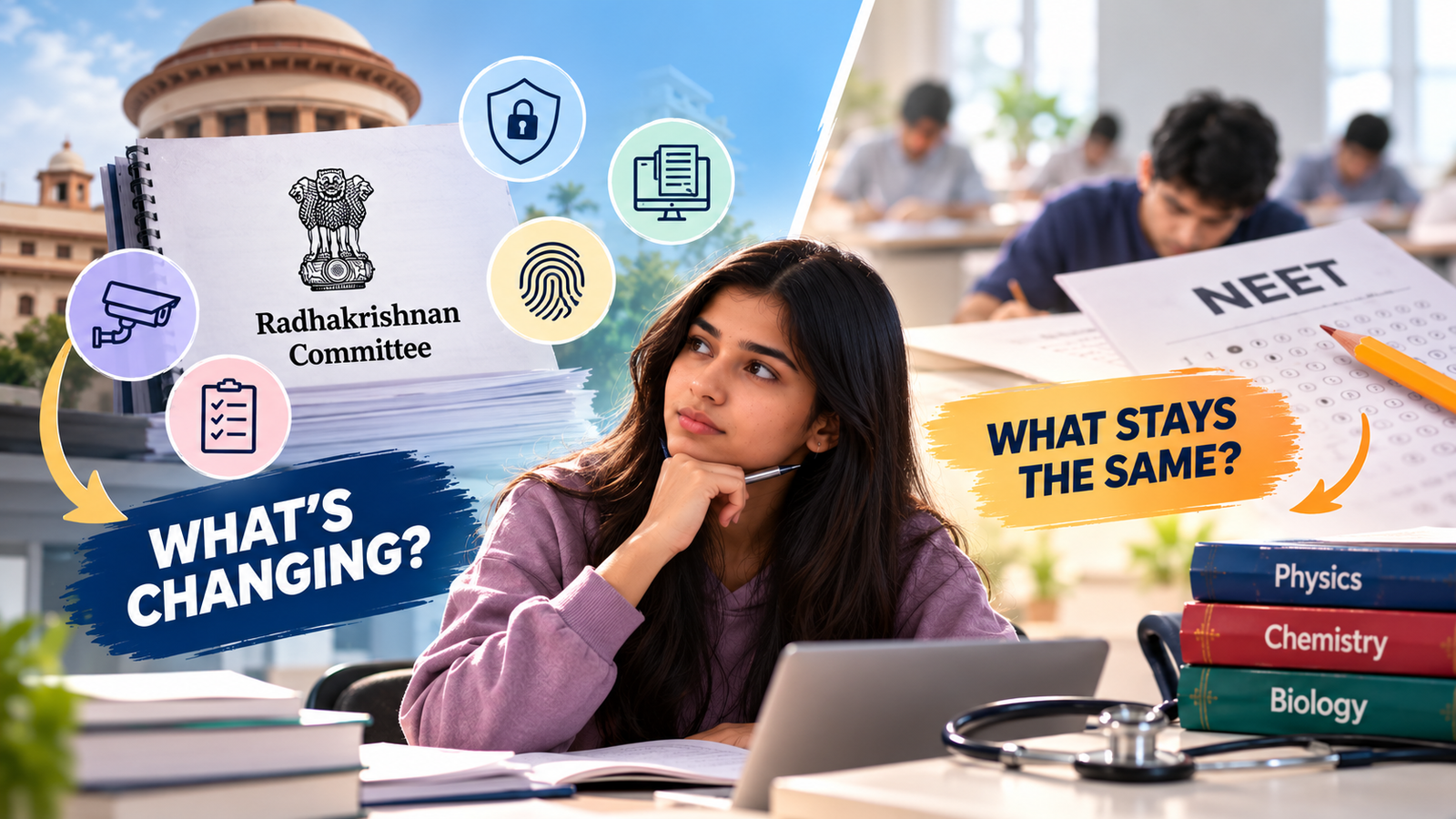
The decision follows the recommendations of a High-Level Committee of Experts headed by former ISRO chairman Dr K. Radhakrishnan. The Ministry of Education set it up in June 2024, after that year's NEET controversy. The committee identified the OMR-based, pen-and-paper system as a key weakness that leaves room for paper leaks, and it recommended CBT along with multi-session testing. Until 2026, NEET-UG was the only major NTA exam still held on paper.
Here's where things stand:
- Confirmed: NEET-UG moves to CBT from 2027. The Education Minister announced it, and the NTA put it on record in an affidavit before the Supreme Court.
- Reported, not yet official: The exam may run over five to six days across about 1,000 centres in around 500 cities. The NTA has asked AICTE to identify government technical institutions with suitable computer labs, and some reputed private institutions may also be used.
- Still awaited: The NEET 2027 information bulletin, with exact shifts, test cities, exam-day rules and any change to the pattern. It is expected after the NTA's restructuring is complete.
Until that bulletin is out, treat anything beyond the CBT decision as a strong indication, not a final rule.
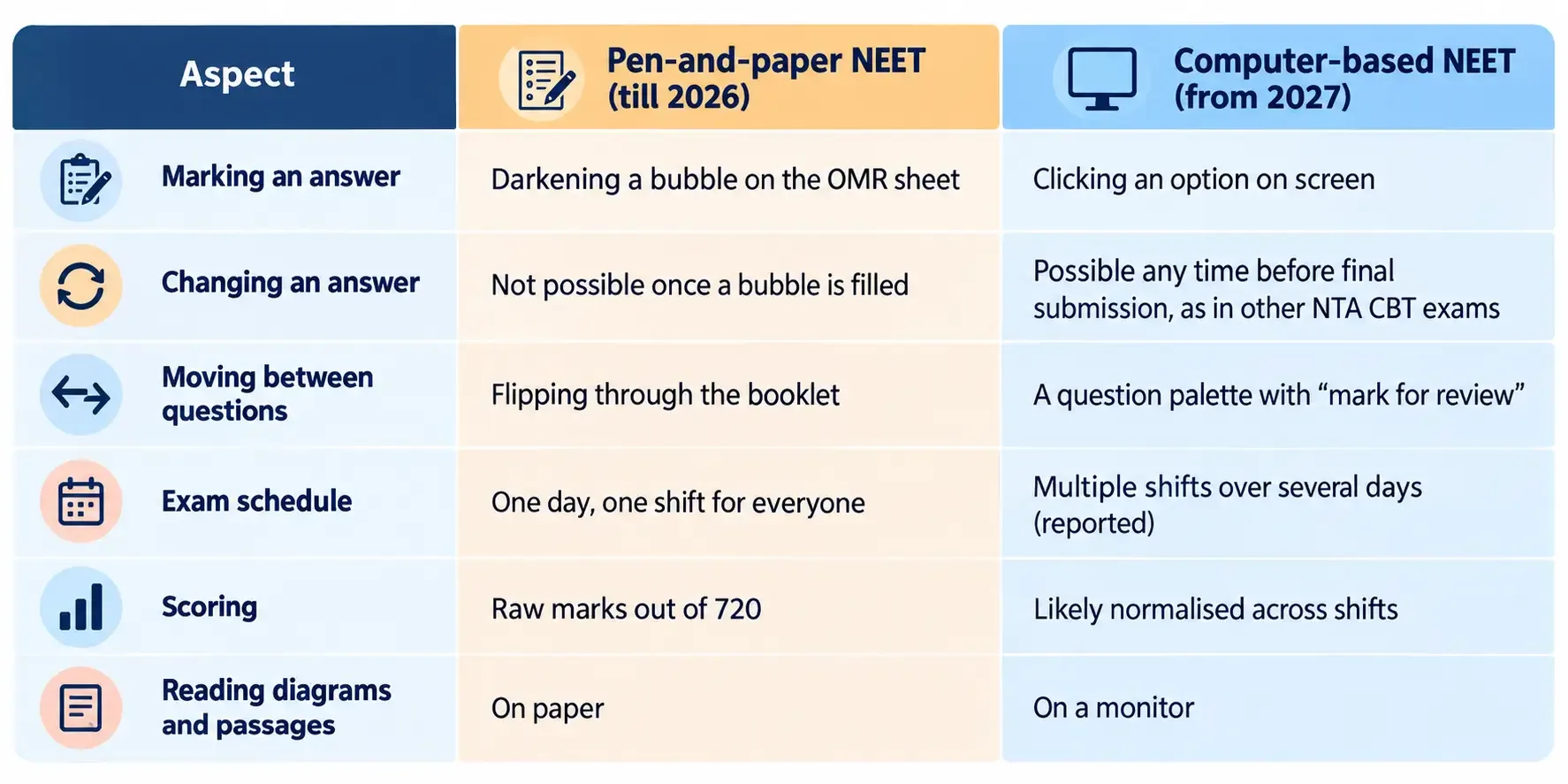
Pen-and-paper vs CBT: what changes on exam day
The syllabus and the physics, chemistry and biology you need to know stay the same. What changes is the experience of sitting the exam.
What CBT means for your preparation
Your shift matters, but not in the way you fear. When an exam runs in several sessions, some papers will feel harder than others. To make that fair, scores are adjusted based on how each candidate performs relative to others in the same session. The NTA already does this for JEE Main. In practice, you're competing with your shift, so steady accuracy beats hoping for an easy paper.
Reading on a screen is a skill. Three hours of assertion-reason questions, graphs and biology diagrams on a monitor is more tiring than on paper. Students who practise on paper alone often find their speed drops on the first few CBT mocks.
Easy answer changes are a double-edged sword. On paper, students rarely change answers. On screen, it's one click, and second-guessing can cost marks. You need a personal rule for when to change an answer, and you only build that through practice.
The content doesn't change. NCERT remains the backbone of NEET. A great CBT strategy can't rescue weak concepts.
How to prepare for a computer-based NEET
You don't need to overhaul your preparation. You need to add a layer to it.
- Keep NCERT at the centre. Concepts, diagrams and NCERT lines still decide most of your marks. Nothing about CBT changes that.
- Move your mocks onto a screen. Start with one computer-based mock every two weeks in the first half of the year, then build to at least one a week in the final months. Your first few CBT scores may dip. That's normal, and it's exactly why you start early.
- Learn the interface until it's boring. Practise using the question palette, "mark for review" and "save and next" so that on exam day your attention goes to the questions, not the buttons.
- Fix an attempt order. Decide whether you start with Biology, Chemistry or Physics, and stick to it in every mock.
- Use your rough sheet with discipline. Other NTA computer-based exams provide rough sheets for calculations. Practise working neatly so you can find your steps again.
- Analyse more than marks. After each mock, check time spent per question and every answer you changed. Did the changes help or hurt you? That data tells you how much to trust your first instinct.
- Follow only official updates. Rely on neet.nta.nic.in and nta.ac.in for the bulletin, not forwarded messages.
- Plan for logistics. With exams spread over several days, your city and shift may be allotted separately. Keep documents ready and plan travel early.
Choosing the best NEET coaching in Hyderabad for the CBT era
The exam mode is changing, but good coaching still rests on the same things: strong concepts, regular tests under real exam conditions, honest analysis afterwards and a routine that keeps students steady for two years. When you visit an institute now, add one more question: how will your test series prepare students for a computer-based NEET?
Why families choose VR Doctors Academy
VR Doctors Academy in Hafeezpet, Miyapur, has been preparing NEET aspirants since 2019. It's a residential campus built around one goal: turning the dream of a white coat into a medical seat.
- Programmes for every stage: BiPC + NEET Residential, Long-Term NEET (2-year) and Short-Term NEET (1-year)
- A five-step method: Learn, Practise, Perform, Analyse, Achieve. Concepts come before memorisation, and practice material builds confidence chapter by chapter.
- Tests that build exam temperament: Regular skill tests simulate exam conditions to sharpen speed, accuracy and time management, which are the same skills a multi-shift CBT exam rewards.
- Paper discussions after every test: Faculty go through mistakes with students, strengthen weak areas and refine exam strategy.
- A focused residential life: Supervised study hours, a structured daily schedule, nutritious meals and a safe campus keep distractions out.
The results show in where students go next. VR Doctors alumni are studying at Osmania Medical College, Gandhi Medical College and Government Medical College, Siddipet, among others, with scores such as 617/720.
Admissions are open. Visit the campus, meet the faculty, see the hostel and ask your questions in person. Call +91 92569 25640, email admissions@vrdoctors.in, or book a campus visit.
Sources
- NEET UG 2027 to be held as computer-based test across 1,000 centres over 5–6 days, Free Press Journal (citing The Indian Express)
- NEET 2027 to shift to computer-based test; NTA asks AICTE to identify exam centres, Medical Dialogues
- NEET UG 2027 moves to computer-based test, The Quint
- VR Doctors Academy
Frequently asked questions
Yes. NEET-UG will move from pen-and-paper OMR sheets to computer-based testing (CBT) from 2027. Union Education Minister Dharmendra Pradhan announced the shift in May 2026, and the NTA confirmed it in an affidavit to the Supreme Court. Detailed rules will come in the NEET 2027 information bulletin.