Insights
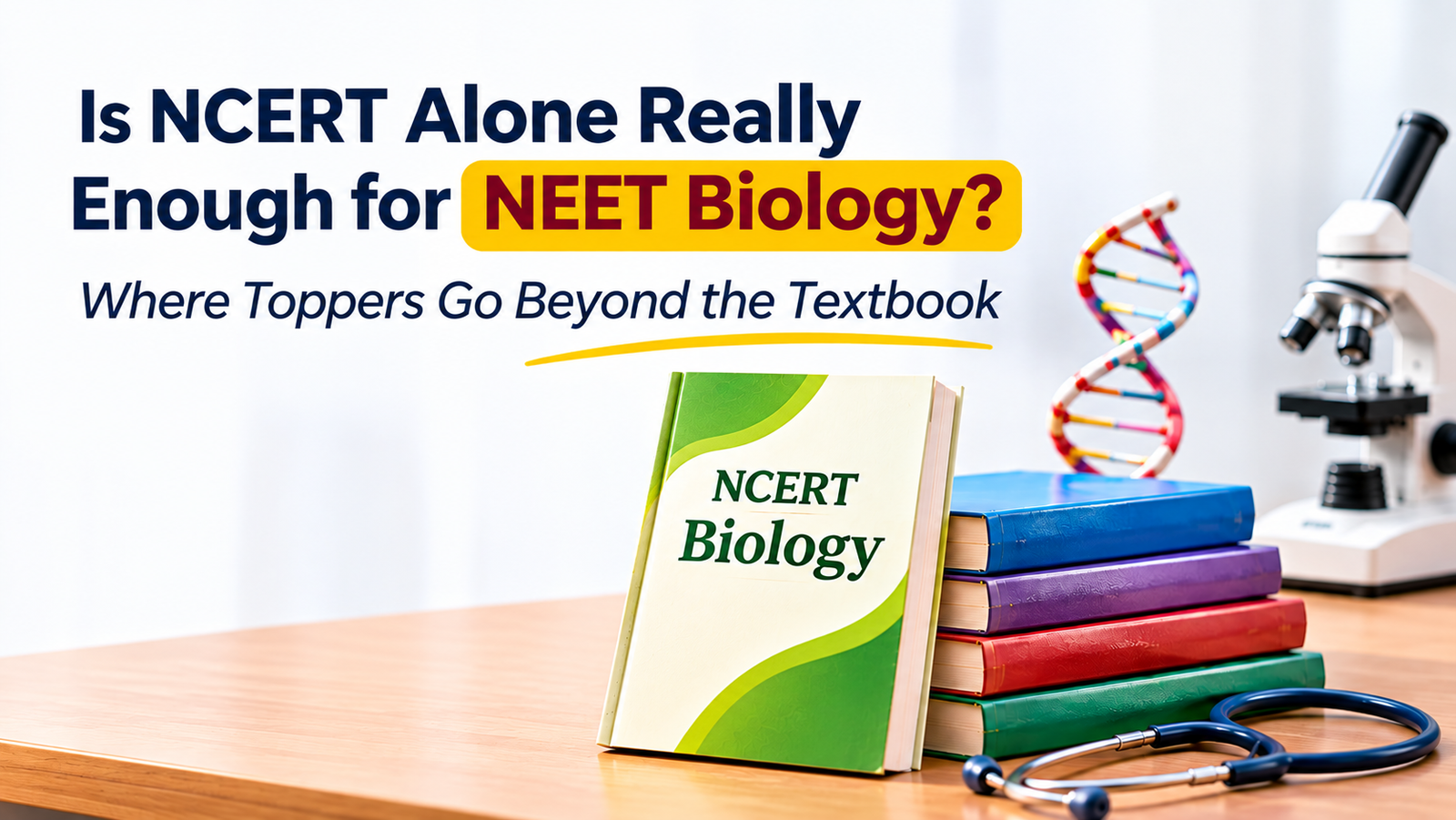
Is NCERT Alone Really Enough for NEET Biology? Where Toppers Go Beyond the Textbook
The question every NEET aspirant asks
Ask any senior how to prepare for NEET Biology and you'll hear the same advice: "Just read NCERT." Then you'll meet a student who read NCERT four times and still lost 40 marks in Biology.
Both stories are true. NCERT is the foundation of NEET Biology, and most questions are built directly on its content. But reading NCERT and mastering NCERT are very different things. Toppers don't just finish the textbook; they squeeze every line, diagram and example out of it, then practise until they can answer any twist the exam throws at them.
So is NCERT alone enough? For understanding, almost. For scoring 340+ out of 360, it's the starting point, not the finish line. Here's where NCERT is enough, where it isn't, and how toppers go beyond the textbook without losing focus.
Why NCERT is non-negotiable
Biology carries half the NEET paper: 360 of the 720 marks. And NEET Biology questions are written around the NCERT Class 11 and 12 textbooks. Many questions lift a line almost word for word, test a specific example, or ask about a labelled part of an NCERT diagram.
That's why every serious preparation plan starts with NCERT. Any reference book that contradicts NCERT, or skips its exact wording, can cost marks. When in doubt, NCERT's version is the one the exam follows.
Where "just NCERT" falls short
The trouble is that many students treat NCERT like a storybook: read it, highlight it, move on. That approach misses what NEET actually tests.
- NEET tests application, not just recall. Assertion-reason questions, statement-based questions and "which of the following is incorrect" formats ask you to use a fact, not just recognise it.
- Small details carry big marks. Footnotes, table entries, figure captions, examples in brackets and summary boxes are frequent sources of tricky questions. They're easy to skim past.
- Reading isn't retention. A student who has read a chapter three times may still forget one exception under exam pressure.
- Some topics need deeper understanding. Genetics problems, the physiology of the heart and kidneys, and plant physiology cycles need conceptual clarity and practice, not just memory.
- Speed matters. Ninety Biology questions inside a three-hour paper shared with Physics and Chemistry means instant recall. That comes only from repeated practice.
So the honest answer is this: NCERT is enough content for NEET Biology. It isn't enough preparation on its own.
Where toppers go beyond the textbook
Toppers don't replace NCERT with other books. They go deeper into NCERT and then beyond the reading.
1. They read NCERT line by line, more than once
The first reading builds understanding. The second and third readings catch details: exceptions, examples, numbers and terms. Many toppers keep a pencil-marked NCERT with notes in the margins and revise from that single copy until exam day.
2. They master every diagram
NCERT diagrams are a favourite source of questions. Toppers practise drawing and labelling key diagrams from memory, such as the human heart, nephron, flower structure, embryo sac and DNA replication, until they can picture every label instantly.
3. They solve previous years' NEET questions chapter by chapter
Previous years' questions show exactly how NCERT lines are turned into questions. Solving them topic by topic, right after studying a chapter, trains students to spot the patterns the exam repeats.
4. They practise MCQs far beyond what NCERT offers
NCERT's end-of-chapter exercises are mostly descriptive. Toppers practise thousands of objective questions, especially assertion-reason, statement-based and match-the-column formats, so no question style feels new on exam day.
5. They use a reference book only to understand, not to add
When an NCERT concept feels unclear, such as genetics crosses or the mechanism of photosynthesis, toppers use a good reference or their teacher's explanation to understand it better. They don't use reference books to memorise extra facts outside the syllabus.
6. They revise with short notes and test themselves
Toppers make one-page summaries of tough chapters, lists of exceptions and tables of examples. Then they test themselves with weekly mock tests and analyse every Biology mistake. The goal isn't more reading. It's making every NCERT line available in seconds.
A simple NCERT-plus study plan
- Learn: Study the chapter from NCERT with your teacher's explanation.
- Reread: Go through it again line by line, marking examples, exceptions and diagram labels.
- Practise: Solve the chapter's previous years' NEET questions and a set of new MCQs.
- Revise: Make short notes, and revisit the chapter within a week.
- Test and analyse: Take topic tests and full mocks, and log every error in a mistake notebook.
Why the right coaching makes NCERT work harder
Most students can't turn NCERT into 340+ in Biology alone. They need someone to explain difficult concepts clearly, a steady supply of exam-style questions, regular tests, and the discipline to revise the same textbook again and again. That's exactly what families look for in the best residential NEET coaching in Hyderabad.
VR Doctors Academy: NCERT mastery, the topper's way
VR Doctors Academy in Hafeezpet, Miyapur, has been preparing NEET aspirants since 2019 through disciplined preparation, residential learning and consistent results.
- Programmes for every stage: BiPC + NEET Residential, Long-Term NEET (2-year) and Short-Term NEET (1-year)
- Learn: Faculty build deep understanding of each concept rather than relying on memorisation.
- Practise: Carefully designed study material and assignments strengthen concepts chapter by chapter.
- Perform: Regular skill tests simulate exam conditions to build speed, accuracy and time management.
- Analyse: Detailed paper discussions after every test help students find their mistakes, fix weak areas and refine their exam strategy.
- A focused residential life: Structured schedules, supervised study hours, nutritious meals and a safe campus give students the time and calm to revise NCERT as often as toppers do.
The results show in where students go next. VR Doctors alumni are studying at Osmania Medical College, Gandhi Medical College and Government Medical College, Siddipet, among others, with scores such as 617/720.
Admissions are open. Visit the campus, meet the Biology faculty, and see how students prepare. Call +91 92569 25640, email admissions@vrdoctors.in, or book a campus visit.
Frequently asked questions
NCERT covers almost all the content NEET Biology tests, so it must be your main book. But reading it alone isn't enough to score high. Toppers combine repeated line-by-line NCERT reading with diagram practice, previous years' questions, extensive MCQ practice and regular mock tests.