Insights
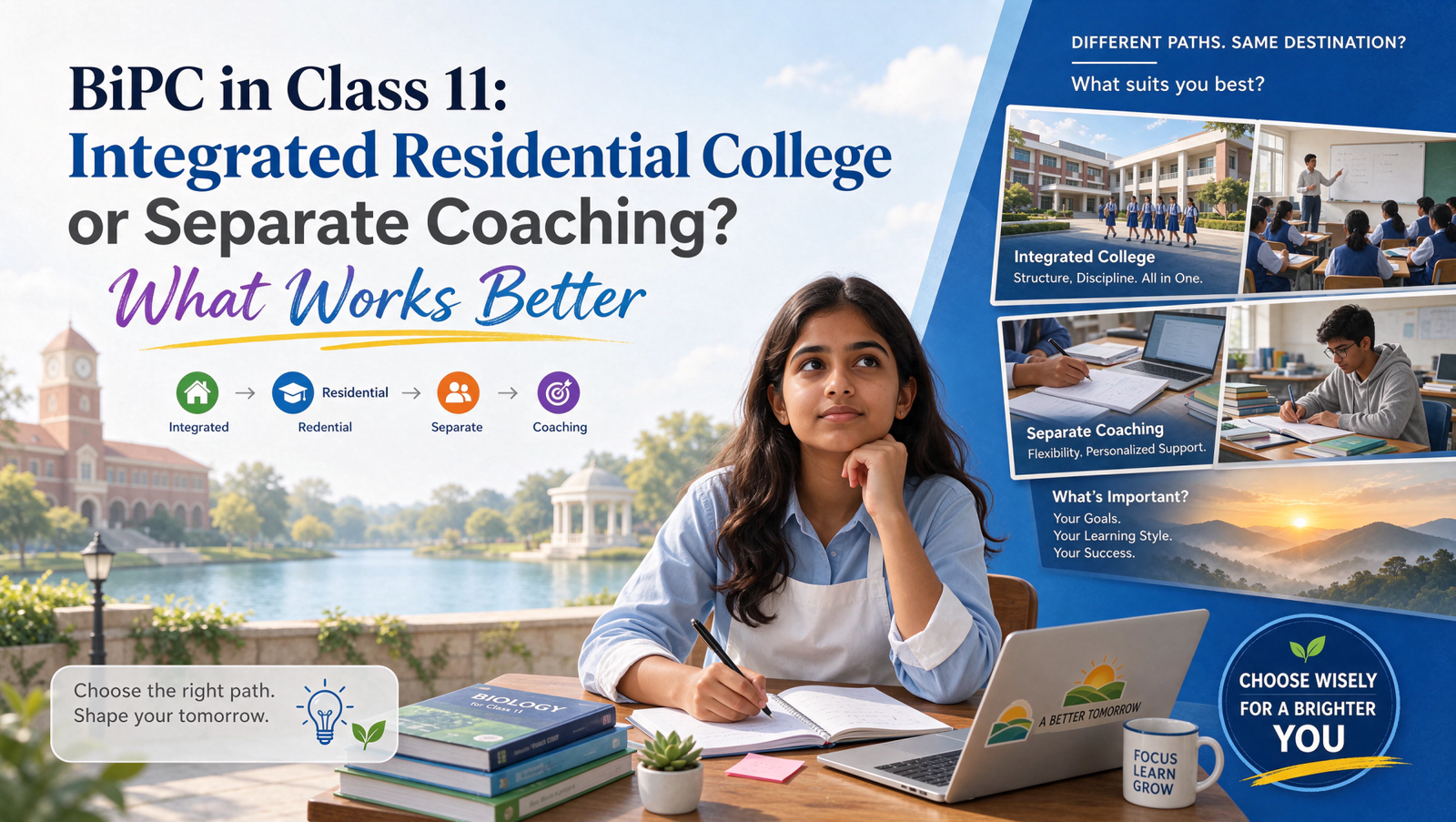
BiPC in Class 11: Integrated Residential College or Separate Coaching? What Works Better
The first big decision after Class 10
Your child has chosen BiPC and wants to become a doctor. Now comes the next question, and it's one many Hyderabad families debate for weeks: should they join a regular junior college and attend NEET coaching separately, or enrol in an integrated residential college where Intermediate and NEET preparation happen together?
On paper, both routes lead to the same exam. In practice, they lead to very different two years. One means juggling two timetables, two sets of teachers, two sets of tests and a commute in between. The other puts everything under one roof and one plan.
There's no single right answer for every student, but there is a clear pattern in what works for most. This guide compares both models honestly, explains when each makes sense, and shows what to look for in the best residential college for NEET in Hyderabad.
The two models, explained
Separate coaching means the student joins a regular junior college for the Intermediate (IPE) syllabus, then travels to a NEET coaching centre in the evenings, on weekends or both. College and coaching are run by different teams with different schedules.
An integrated residential college combines the Intermediate syllabus and NEET coaching in one timetable, taught by one faculty team, on a campus where students also live. Classes, self-study, tests and hostel life are planned together.
Side-by-side comparison
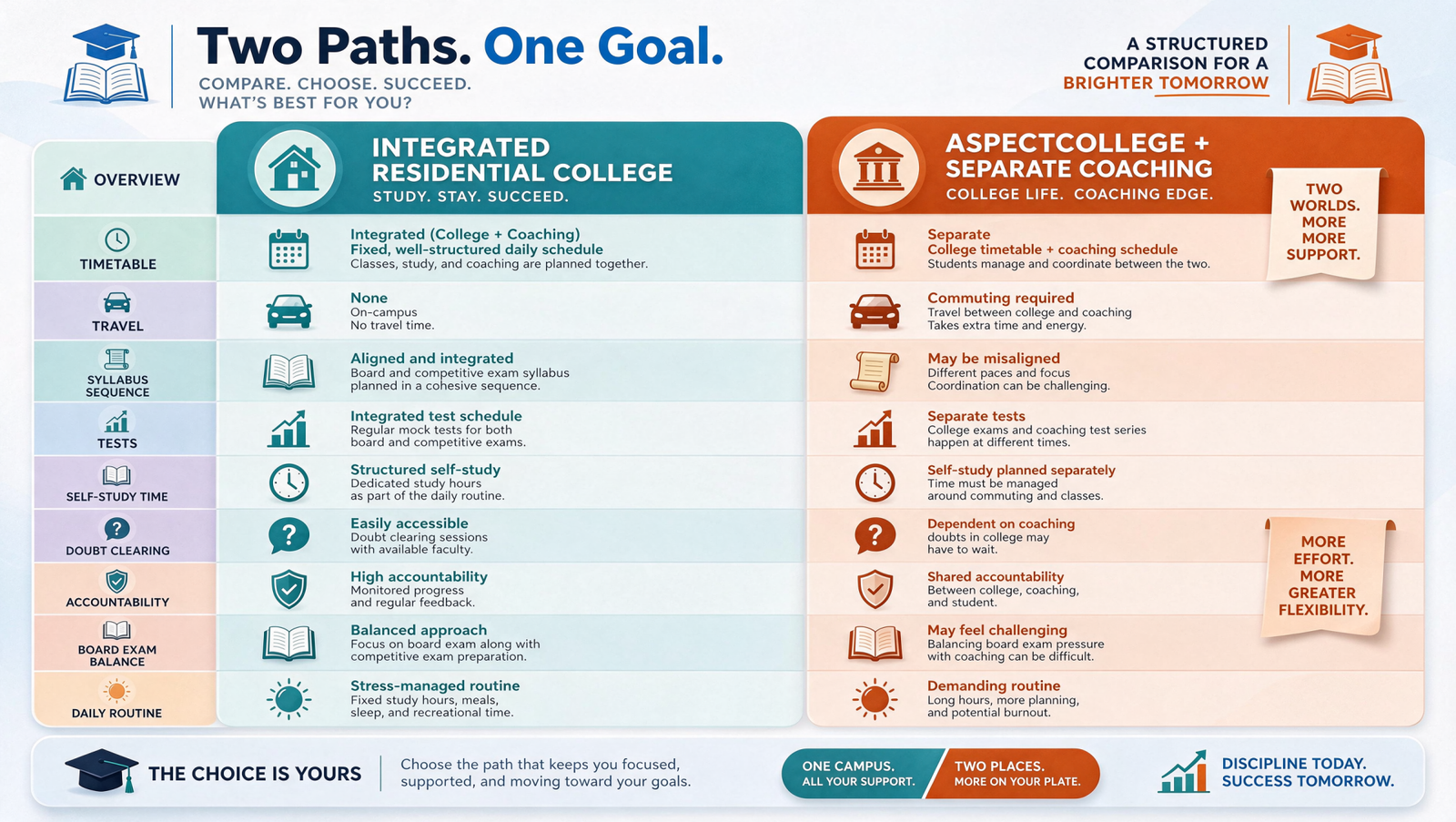
The biggest difference isn't the teaching. It's the coordination. When two institutions plan independently, the student becomes the one stitching the two together, usually at the cost of rest and self-study.
Why the integrated model works better for most BiPC students
1. Board and NEET reinforce each other
The Intermediate BiPC syllabus and NEET overlap heavily, and both rest on NCERT-style concepts. When the same faculty teach a chapter once for both exams, students learn it deeper and revise it faster. With separate institutions, the same chapter may be taught twice, months apart, in two different styles.
2. Class 11 is when habits are formed
Class 11 is the hardest transition in a student's school life. The syllabus jumps in depth, and Biology alone feels like a mountain of new terms. Students who build a steady daily routine in the first few months usually keep it for two years. A fragmented schedule with long commutes makes that much harder.
3. Hours saved become study hours
A student shuttling between college, coaching and home can lose two to three hours a day. Over two years, that's time that could have gone into revising NCERT Biology several more times. In an integrated residential programme, those hours go into supervised self-study and sleep.
4. One team owns the student's progress
When scores drop, someone needs to notice, find the reason and step in. In the separate model, the college sees board marks, the coaching centre sees NEET scores, and nobody sees the whole picture. An integrated college tracks both and acts on both.
5. Less burnout
Two test calendars, two sets of homework and late nights wear 16-year-olds down. A single coordinated plan keeps the workload heavy but manageable, which matters over a two-year race.
When separate coaching can still work
To be fair, the separate model can work for some students:
- The college and the coaching centre are very close to home
- The student is unusually self-driven and already manages time well
- The coaching centre's schedule is designed around the college's timings
- The family can closely follow both institutions' updates
Even then, it asks a lot of a 16-year-old. For most BiPC students, an integrated programme removes problems before they start.
Questions to ask any integrated residential college
- Do the same faculty teach both the IPE and NEET syllabus?
- How are board exam preparation and NEET preparation balanced in Class 12?
- How many hours of supervised self-study are built into each day?
- How often are tests held, and is every test followed by analysis?
- Are the boys' and girls' hostels separate, supervised and monitored?
- How do mentors track each student's progress, and how often do parents hear about it?
- How many students from last year's batch wrote NEET, and how many secured seats?
VR Doctors Academy: an integrated residential path from Class 11 to medical college
For families searching for the best residential college for NEET in Hyderabad, VR Doctors Academy in Hafeezpet, Miyapur, was built for exactly this decision. Since 2019, it has helped BiPC students turn the dream of a white coat into medical seats through disciplined preparation, residential learning and consistent results.
- BiPC + NEET Residential: A two-year integrated programme that combines the Intermediate BiPC syllabus with NEET preparation in one plan
- Learn, Practise, Perform, Analyse, Achieve: Concepts first, then smart study material, regular skill tests under exam conditions and detailed paper discussions after every test
- A real study culture: Structured schedules and supervised study hours make daily revision a habit from the first month of Class 11
- A safe, caring residential campus: Nutritious meals, a secure environment, and festivals and sports days that keep students balanced
- Beyond MBBS: Guidance on the wider world of BiPC, including BDS, AYUSH and other healthcare careers
- For later stages too: Long-Term NEET (2-year) and Short-Term NEET (1-year) programmes for students preparing after Intermediate
The results show in where students go next. VR Doctors alumni are studying at Osmania Medical College, Gandhi Medical College and Government Medical College, Siddipet, among others, with scores such as 617/720.
Admissions for Class 11 BiPC are open. Visit the campus, meet the faculty, see the hostel and ask every question on the checklist above. Call +91 92569 25640, email admissions@vrdoctors.in, or book a campus visit.
Frequently asked questions
For most BiPC students, yes. An integrated college teaches the Intermediate syllabus and NEET preparation in one timetable with one faculty team, which removes commuting, clashing schedules and duplicate tests. Separate coaching can work for highly self-driven students who live close to both institutions.