Insights
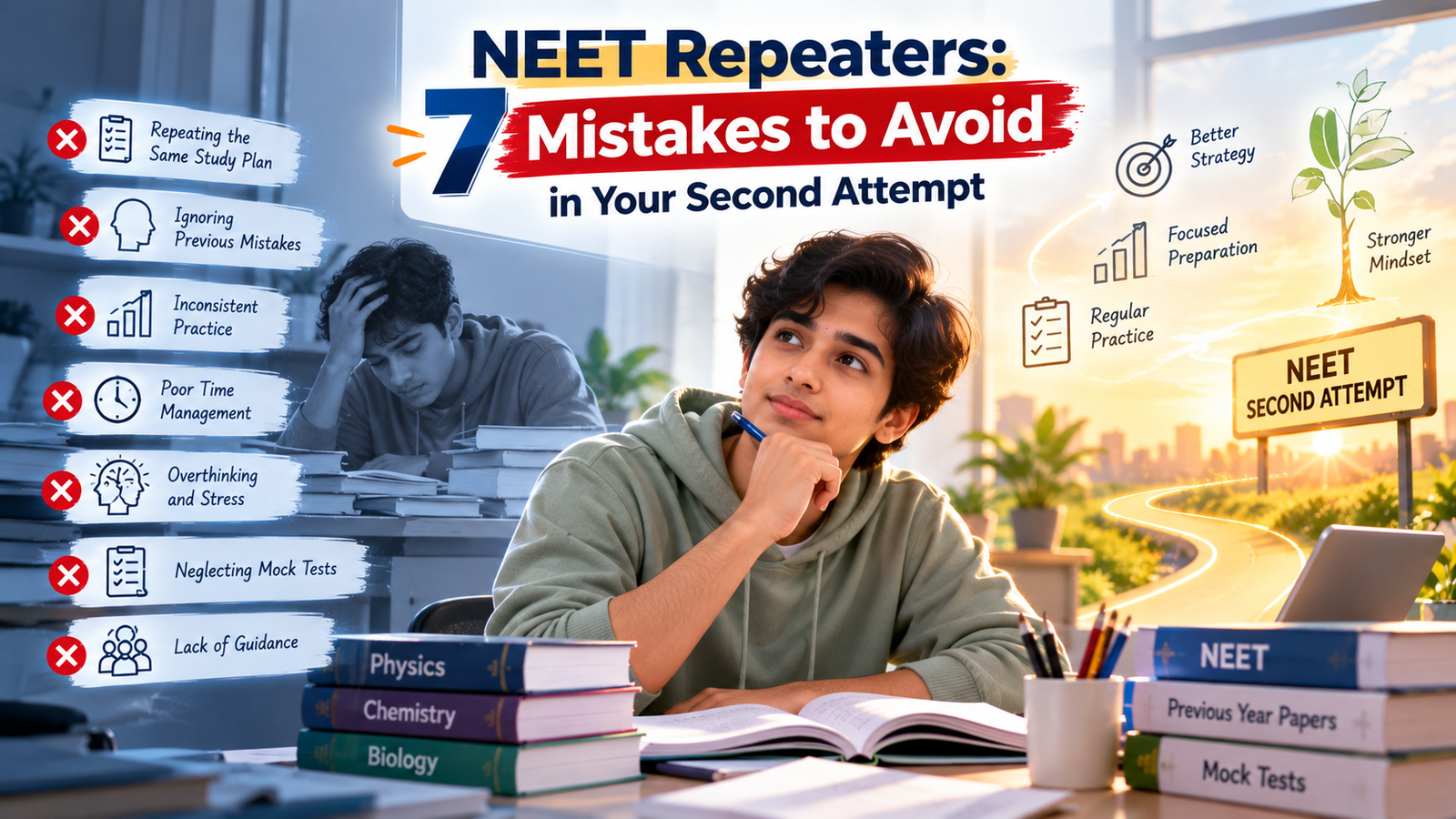
NEET Repeaters: 7 Mistakes to Avoid in Your Second Attempt
The result comes out. You check your score once, then again, hoping you read it wrong. You didn't. The seat you worked for slipped away, maybe by a few marks, maybe by more.
If you're reading this, you've probably decided to try again. That decision takes real courage. Plenty of students who are now doctors cracked NEET on their second attempt, and many of them will tell you the drop year taught them more than anything else.
But here's the honest truth: a second attempt doesn't automatically mean a better score. Some repeaters jump 150 marks. Others end up close to where they started. The difference usually isn't intelligence or even effort. It comes down to avoiding a handful of mistakes that quietly eat away at a drop year.
Here are the seven most common ones, and how to steer clear of them.
Mistake 1: Repeating the Same Strategy and Expecting a Different Result
This is the biggest trap. Many repeaters simply pick up their books and start again from chapter one, using the same methods that didn't work the first time.
Before you study anything, sit down with your previous attempt. Which subject cost you the most marks? Did you run out of time? Did silly errors pile up? Were there chapters you skipped entirely hoping they wouldn't come?
Write it all down honestly. Your first attempt is the most useful study material you have, because it shows exactly where your preparation broke down. A second attempt should be built around fixing those gaps, not repeating the entire journey.
Mistake 2: Collecting Too Many Books
After a disappointing result, it's tempting to believe the problem was your study material. So students buy three new reference books for each subject, subscribe to extra test series, and save dozens of YouTube playlists.
Most of this ends up half-finished. NEET rewards depth, not variety. For Biology especially, NCERT is the backbone of the paper, and a large share of questions come straight from its lines, diagrams, and examples. Many repeaters lose easy marks in Biology because they drifted away from NCERT toward heavier books.
Pick one solid resource per subject, finish it completely, and revise it multiple times. Rereading the same book three times will do far more for you than skimming five.
Mistake 3: Polishing Strong Subjects and Avoiding Weak Ones
It feels good to study what you're already good at. If Biology is your strength, spending hours on it gives you a sense of progress. Meanwhile, Physics sits in the corner, quietly waiting to drag your score down again.
This is human nature, but it's costly. Moving Physics from 80 to 140 is often far more achievable than pushing Biology from 320 to 340. Your weak subject is where your biggest score jump is hiding.
Give it dedicated daily time, even when it's uncomfortable. Start with concepts, then move to numericals chapter by chapter. Ask doubts immediately instead of letting them pile up. Confidence in a weak subject is built slowly, one solved problem at a time.
Mistake 4: Taking Mock Tests Without Analysing Them
Some repeaters take a mock test every day and still see their scores stay flat. The reason is simple: the test is only half the work. The real learning happens afterwards.
After every mock, spend at least as much time reviewing it as you did writing it. Sort your mistakes into categories. Was it a concept you didn't know? A calculation error? A question you misread? A guess that went wrong?
Patterns will start showing up quickly. Maybe you consistently lose marks in Organic Chemistry, or you rush through the last 30 minutes. Once you see the pattern, you can fix it. Without analysis, you're just repeating the same mistakes under exam conditions.
Also pay attention to negative marking. Many repeaters lose 20 to 40 marks purely through risky guesses. Learning when to leave a question is a skill in itself.
Mistake 5: Letting Isolation and Pressure Take Over
This one rarely gets talked about, but it affects almost every repeater.
Your friends have moved on to college. Their social media is full of new campuses and new friends. Relatives ask awkward questions at family functions. You spend long hours alone with your books, and the self-doubt grows louder.
A drop year can feel lonely, and that emotional weight directly affects how well you study. Students who stay isolated often burn out by the middle of the year.
Stay connected with people who support you. Talk to your parents honestly about how you feel. Take short breaks, get some physical activity, and sleep properly. Studying among other serious aspirants also helps a lot, because you realise you're not the only one fighting this battle.
Mistake 6: Having No Fixed Daily Routine
Without the structure of school or college, a drop year can quietly lose its shape. You wake up late, study in bursts, scroll through your phone "for just five minutes," and the day disappears.
Twelve months sounds like a lot of time. It isn't. Wasted weeks add up fast, and many repeaters realise in February that they're behind schedule.
Build a routine that mirrors exam conditions. Fix your wake-up time, study in focused blocks, and schedule revision and testing into your week. Keep your phone away during study hours. Consistency over twelve months will beat occasional bursts of 14-hour study days every single time.
Mistake 7: Choosing the Wrong Coaching, or None at All
Some repeaters decide to prepare entirely on their own to save money or avoid pressure. It can work for a few highly disciplined students, but most struggle without doubt support, structured testing, and someone tracking their progress.
Others make the opposite mistake: they join a huge institute where they become one face among hundreds, and nobody notices when they fall behind.
What a repeater really needs is personal attention, a structured long-term plan, regular tests with proper analysis, and an environment that keeps distractions away. That's why choosing the best NEET coaching in Hyderabad for your second attempt matters so much. The right institute doesn't just teach the syllabus again. It helps you fix exactly what went wrong the first time.
Why a Residential NEET Long Term Programme Works for Repeaters
Look back at the mistakes above. Isolation, no routine, distractions, unanalysed tests, and weak subjects left unattended. A good residential long-term programme addresses almost all of them together.
You live and study among students with the same goal. Your day has a fixed timetable. Faculty are available to clear doubts before they pile up. Meals, rooms, and daily logistics are taken care of, so your energy goes into preparation rather than managing everything yourself.
VR Doctors: Built for Students Who Want That Medical Seat
At VR Doctors Academy, the NEET Long Term programme is designed with repeaters in mind. The focus is on stress-free, structured preparation, with experienced faculty, regular testing, and personal attention that keeps each student on track.
Students often mention the things that make the biggest difference over a long year: homely food, hygienic hostel rooms, supportive lecturers, and an environment where they can simply focus on studying. Our alumni have gone on to medical seats at colleges including Osmania University, and our very first batch saw students secure MBBS A-category seats.
For families searching for the best NEET coaching in Hyderabad, what matters most is how an institute supports a student through the hard months, not just the results brochure. That's where our residential model makes the difference.
If you're planning your second attempt, visit VR Doctors or call +91-7097098877 to talk to our team about the NEET Long Term programme.
A second attempt is a fresh start with one big advantage: you already know what the exam feels like. Use that knowledge wisely. Avoid these seven mistakes, stay consistent, and surround yourself with the right support.
The white coat is still within reach. This time, go after it with a better plan.
Frequently asked questions
Yes, for many students. A drop year gives you time to fix weak subjects and gain exam experience. The key is changing your strategy, not just repeating it.