Insights
Radhakrishnan Committee Reforms Explained: What’s Actually Changing in NEET and What Stays the Same
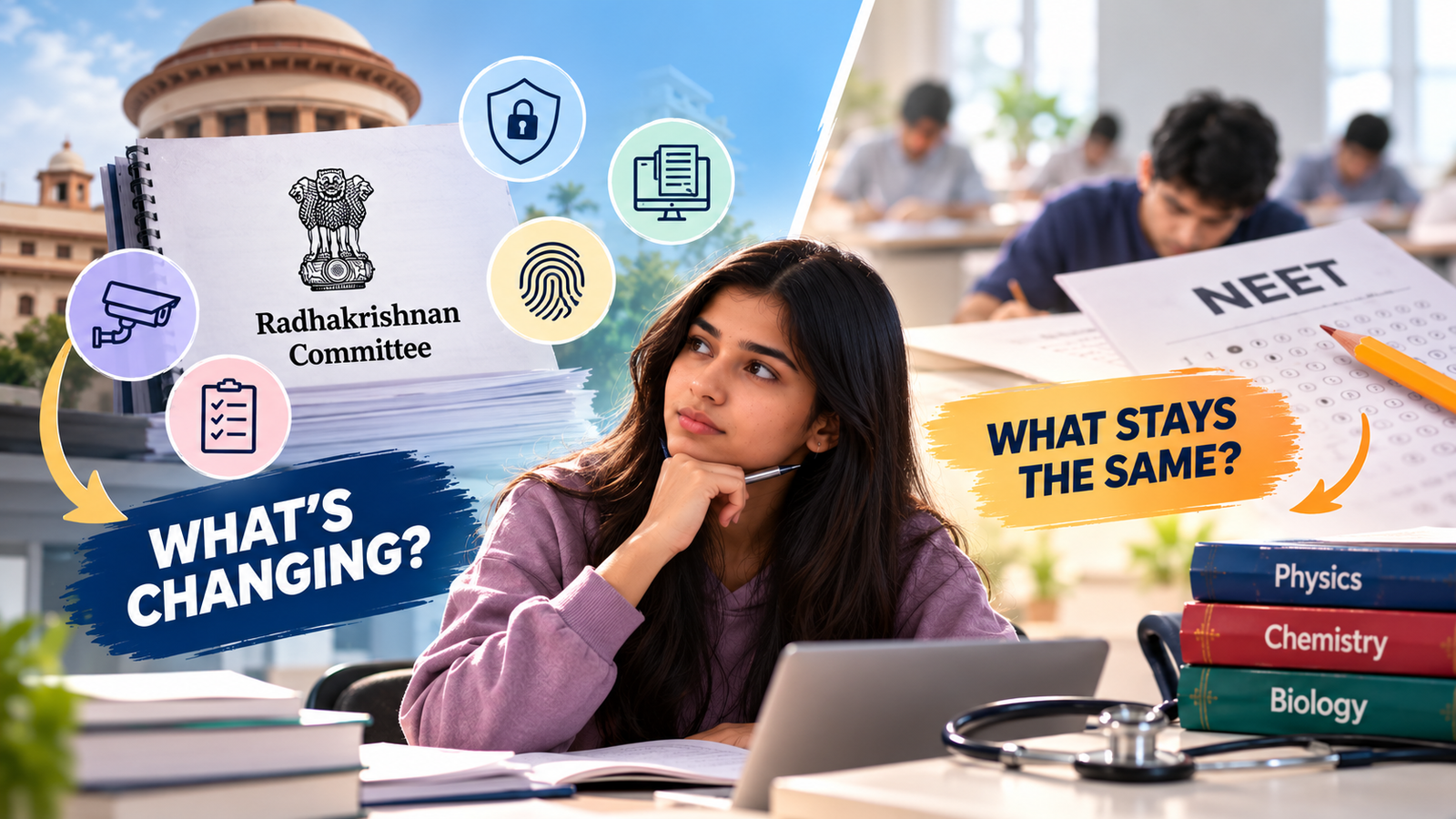
NEET has been through several changes in recent years, and students and parents are understandably asking what comes next.
The Radhakrishnan Committee, constituted by the Ministry of Education in June 2024 after concerns surrounding the NEET-UG 2024 examination, was asked to recommend reforms covering the examination process, data security and the functioning of the National Testing Agency (NTA). The committee submitted its report in October 2024 with 101 recommendations.
But there is an important distinction that students should understand:
A recommendation is not automatically a rule.
Some recommendations have already moved into implementation, while others are intended as medium- or long-term reforms. The government has also continued to review examination security and the functioning of NTA. As of 2026, several security and authentication measures have been introduced, while some larger proposed changes remain under phased implementation.
So, what does this mean for a student preparing for NEET?
Let's separate the proposed reforms from the things that students can continue preparing for as usual.
Why Was the Radhakrishnan Committee Formed?
The committee was created following concerns about the conduct and integrity of NEET-UG 2024.
The 2024 examination was conducted in pen-and-paper mode for around 24 lakh candidates across hundreds of cities. Following reports of question-paper leaks and other irregularities, the Ministry of Education established a seven-member High-Level Committee of Experts chaired by Dr. K. Radhakrishnan.
Its responsibilities went beyond simply looking at question-paper security.
The committee examined the broader testing life cycle, including:
- Examination preparation
- Question-paper security
- Printing and transportation
- Candidate authentication
- Examination-centre management
- Data security
- Technology
- Grievance handling
- NTA's organisational structure
- Examination monitoring
The committee's report therefore represents a much broader examination-reform plan rather than simply a proposal to change the NEET question paper.
What Is Actually Changing?Several recommendations have already translated into measures or implementation activity.
1. Stronger Candidate Authentication
One of the important areas of reform is candidate verification.
The committee proposed DIGI-EXAM, a multi-stage authentication framework intended to verify candidates across different stages of the examination and admission process.
The idea is to move beyond relying on a single identity check on examination day.
According to reporting on the implementation of the committee's recommendations, Aadhaar-based biometric authentication has been introduced for NEET-UG candidates as part of the first phase of the proposed system. Other security measures include enhanced surveillance and AI-based analytics.
For students, this means that identity verification and examination security are receiving significantly more attention.
2. Greater Use of Technology for Examination Security
The committee recommended using technology throughout the examination process.
One of its major proposals was Computer-assisted Secure Pen-and-Paper Testing (CPPT).
This is different from simply converting NEET into a computer-based examination.
Under the proposed model, encrypted question papers could be digitally transmitted to secure examination centres and printed shortly before the examination. Students would still answer on physical paper. The objective is to reduce risks associated with transporting printed question papers over long distances.
This is an important distinction because many students hear about "digital NEET" and assume that the entire examination will immediately move to computers.
That is not what the original recommendation says.
3. More Secure Examination Centres
The committee recommended reducing dependence on private examination infrastructure by developing a network of secure testing centres, including government institutions.
It proposed developing at least 1,000 secure testing centres in phases, with appropriate technical infrastructure, power supply, candidate facilities, help desks and other requirements.
The broader objective is to make examination centres more secure and better equipped.
For students, the practical impact could include stronger surveillance, identity checks, centre-level security and better coordination.
4. Stronger NTA Structure
The reforms are not limited to NEET itself.
The committee recommended restructuring and strengthening NTA, including changes to its governing structure, additional expertise and dedicated functional areas.
The report argued that the organisation's capacity needed to be strengthened given the scale and complexity of the examinations it conducts.
The government has subsequently taken steps related to strengthening NTA, including adding senior-level posts and improving institutional coordination.
For students, this is mostly an administrative change rather than something that alters the syllabus they study every day.
What Has Not Changed?This is perhaps the most important part for NEET aspirants.
The Radhakrishnan Committee made several recommendations about how examinations should be conducted and secured. It did not replace NEET with an entirely different medical entrance system.
The official NTA NEET website continues to describe NEET-UG as the common national entrance examination for undergraduate medical education in India. The 2026 examination remained a common and uniform NEET-UG examination.
That means students should not assume that the committee's recommendations have suddenly changed the fundamentals of NEET preparation.
The core preparation principles remain important:
- Understanding the prescribed syllabus
- Strong NCERT-based conceptual preparation
- Regular question practice
- Revision
- Mock examinations
- Time management
- Accuracy
- Error analysis
- Consistent preparation
The examination-security reforms are primarily about making the testing process safer, more reliable and more transparent.
They do not remove the need for academic preparation
.
Is NEET Becoming a Computer-Based Exam?This is one of the biggest questions students have.
The committee recommended exploring several examination formats, including hybrid approaches, multi-session testing and, over the longer term, computer-adaptive testing.
However, these are recommendations and phased possibilities—not something students should automatically assume has become the immediate NEET format. The committee itself described several of these as longer-term reforms.
For example, the proposed CPPT model would retain pen-and-paper answering while using secure digital transmission for question papers.
Therefore, students should rely on the official NTA notification for the specific NEET year rather than social-media claims about a sudden format change.
Could NEET Be Conducted in Multiple Sessions?The committee recommended considering multi-session testing for examinations involving very large numbers of candidates.
It also discussed multi-stage testing and computer-adaptive testing as longer-term possibilities.
If multiple sessions are eventually introduced, the committee recommended that the normalisation process should be transparent and properly documented.
But students should not change their preparation strategy based only on the possibility of future multi-session examinations.
Until the official examination authority announces the format for a particular year, preparation should follow the officially notified pattern.
What About AI in NEET?AI is another major part of the proposed examination ecosystem.
The committee recommended greater use of technology and AI-based analytics for areas such as examination monitoring, security and grievance handling.
It also proposed AI/ML-supported interactive systems that could help candidates receive answers to examination-related queries in different languages.
However, this does not mean that AI will decide who qualifies for NEET.
AI-related recommendations are largely focused on strengthening examination administration, security, analytics and candidate support.
For students, AI can also become a useful learning tool, but it should complement—not replace—textbooks, teachers, problem-solving and mock tests.
Will the NEET Syllabus Change Because of These Reforms?The Radhakrishnan Committee's mandate was primarily focused on examination processes, security and NTA's structure.
Therefore, students should not interpret the committee report itself as a syllabus-change notification.
If the syllabus, examination pattern, eligibility criteria or other candidate requirements change, students should look for an official notification from the relevant examination authority.
This is particularly important because online discussions often combine committee recommendations, student demands, media reports and confirmed examination rules as though they are all the same thing.
They are not.
What Should NEET Students Do Differently?The safest approach is not to panic over every reported reform.
Instead, students should build preparation habits that remain useful regardless of reasonable changes in examination administration.
1. Build strong concepts
Don't prepare only for a particular question pattern.
Understand the underlying Physics, Chemistry and Biology concepts.
2. Practise different question formats
If examination systems evolve, students with strong conceptual understanding and problem-solving ability are better positioned to adapt.
3. Take timed tests
Even if the examination format changes in the future, time management and accuracy will remain important.
4. Analyse mistakes
Don't simply record your score.
Find out whether mistakes came from:
- Lack of knowledge
- Misreading
- Calculation errors
- Guessing
- Time pressure
- Confusion between similar concepts
5. Follow official announcements
This is especially important as reforms are being implemented in phases.
The NTA website currently publishes official NEET notices, answer keys, examination information and candidate updates.
What Parents Should UnderstandParents may hear terms such as AI-based monitoring, biometric verification, computer-based testing, multi-session NEET and digital question papers and assume that the entire examination system is changing immediately.
That is not necessarily the case.
The Radhakrishnan Committee proposed a broad roadmap. Some recommendations have already influenced implementation, while others require additional planning, infrastructure and coordination.
The government's implementation process has also included a High-Powered Steering Committee chaired by Dr. Radhakrishnan to monitor the recommendations.
Therefore, parents should encourage students to stay informed without allowing examination-reform news to disrupt their preparation.
The Bigger Picture: What Is the Committee Trying to Achieve?At its core, the Radhakrishnan Committee's recommendations are about improving confidence in the examination system.
That involves more than preventing question-paper leaks.
A reliable examination system needs:
Secure question papers → verified candidates → secure centres → reliable technology → transparent processes → effective grievance handling → accountable administration
The report therefore looked at NEET and other NTA examinations as an interconnected system rather than focusing on one isolated problem.
For students, the most important takeaway is simple:
The examination system may evolve, but strong preparation remains the most dependable foundation.
The Radhakrishnan Committee report represents a roadmap for strengthening India's examination system, not an instruction for students to completely change how they prepare for NEET.
Some reforms—particularly around candidate authentication, surveillance, examination security and NTA capacity—are already being implemented. Other proposals, such as multi-session testing, hybrid examination systems and longer-term computer-adaptive testing, involve further phases of implementation.
For NEET aspirants, the best response to changing examination systems is not confusion or constant speculation. It is to build strong fundamentals, practise consistently, analyse mistakes and stay updated through official sources.
VRDoctors can help students and parents understand the changing NEET landscape while keeping the focus where it belongs: strong academic preparation, informed decision-making and consistent progress toward a medical career.
Frequently asked questions
The Radhakrishnan Committee was a High-Level Committee of Experts established by the Ministry of Education in 2024 to recommend reforms for NTA examinations. Its areas of focus included examination processes, data security and NTA's structure and functioning. It submitted 101 recommendations.